Kindly review our updated billing policies and procedures prior to attending your appointment. Questions can be sent to info@wholetherapy.ca
View Billing Policies and Procedures
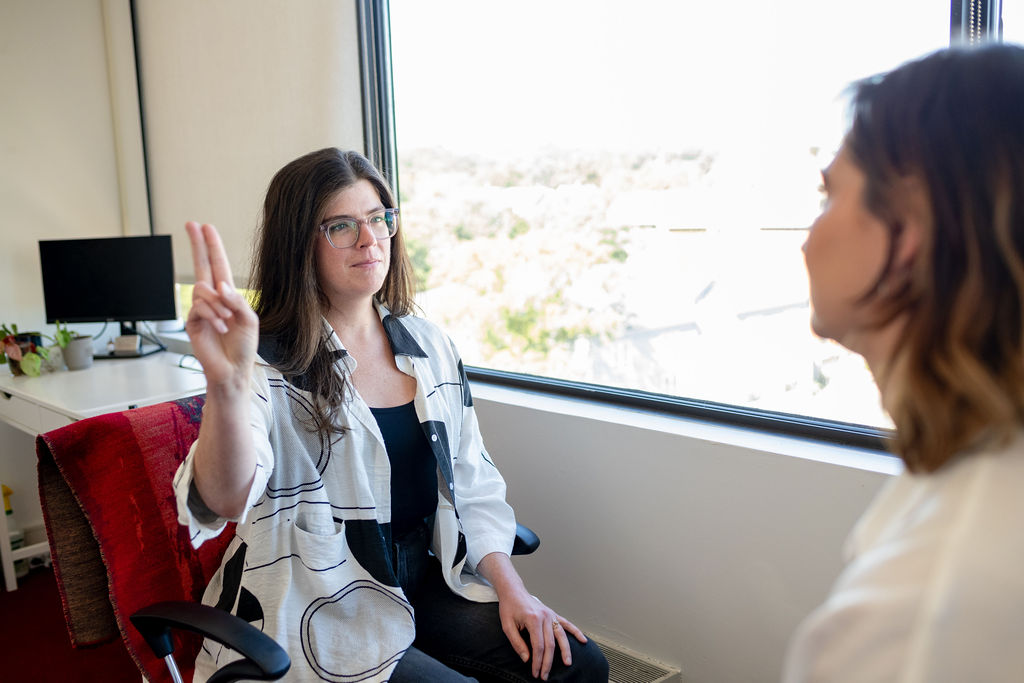
A gentle, evidence-based therapy that helps your nervous system process what your mind has been carrying.
EMDR stands for Eye Movement Desensitization and Reprocessing. It's a structured therapy developed to help people recover from trauma by getting unstuck from memories that keep playing on a loop.
When something traumatic happens, the brain doesn't always finish processing it. The memory stays raw. You can know intellectually that you're safe now, but your body still reacts like the threat is happening. EMDR works directly with the nervous system to help that processing finally complete.
You don't have to relive the worst moments in detail. The goal isn't to forget what happened. It's to get to a place where the memory no longer runs the show.

You don't need to have survived a single dramatic event for EMDR to help. It's effective for many kinds of distress, including the kind that builds up slowly over years.
EMDR follows an eight-phase protocol. Every phase has a purpose, and no two clients move through them at the same pace.
A common worry about EMDR is that it means jumping straight into the hardest stuff. That's not how it works.
Most practices offer EMDR as one option among many. At Wholetherapy, it's a core clinical specialization with a level of training that goes well beyond the basics.
As a Halifax Region practice where EMDR is a core specialization and focus, nearly every clinician at Wholetherapy is EMDR trained. We work with clients in person from our Dartmouth office — minutes from Halifax — and virtually across Nova Scotia.
See which of our EMDR therapists in Halifax are accepting new clients, with credentials and direct booking.
Yes. Virtual EMDR is well established and, for most people, works as well as in person. The bilateral stimulation is delivered on screen. You follow a moving visual cue, or use alternating tones through headphones, and the eight-phase protocol is otherwise unchanged.
What virtual sessions ask of you is a private space where you will not be interrupted, a stable connection, and headphones. Your therapist will also set up a grounding plan for the end of each session, since you will not have the natural transition of leaving an office.
Virtual is not the right fit for everyone. If you dissociate significantly, or if home is not a place you feel safe, your therapist may recommend starting in person at our Dartmouth office and moving online later. That is a conversation for your free consult.
We offer virtual EMDR across Nova Scotia, and elsewhere in Atlantic Canada subject to clinician licensure and availability.
Yes, though most people end up doing some of both. Talk therapy works largely through conversation: understanding what happened, naming patterns, building insight. EMDR works through the nervous system. Rather than explaining a memory in depth, you hold it in mind while your therapist guides bilateral stimulation, and the brain does the processing.
That difference matters most when you already understand your history intellectually but your body still reacts as though the threat is present. Insight alone often does not shift that; EMDR frequently does.
Many clients at Wholetherapy do both. Stabilization and the work between sessions look a lot like good talk therapy, and the processing phases are EMDR. Your therapist will talk with you about which the work calls for.
Wholetherapy runs EMDR consultation groups for clinicians seeking structured support, advanced learning, and consultation toward EMDR certification. Groups are offered approximately twice per year. Join the waitlist to be notified when the next group opens.